
Categories
Coastal Living, Best Places to Live, Connecticut Real Estate, Education & Schools, Family-Friendly Living, Lifestyle & CommunityPublished October 6, 2026
The Houses That Tell Connecticut’s Story: An October Road Trip Through Centuries of New England Architecture

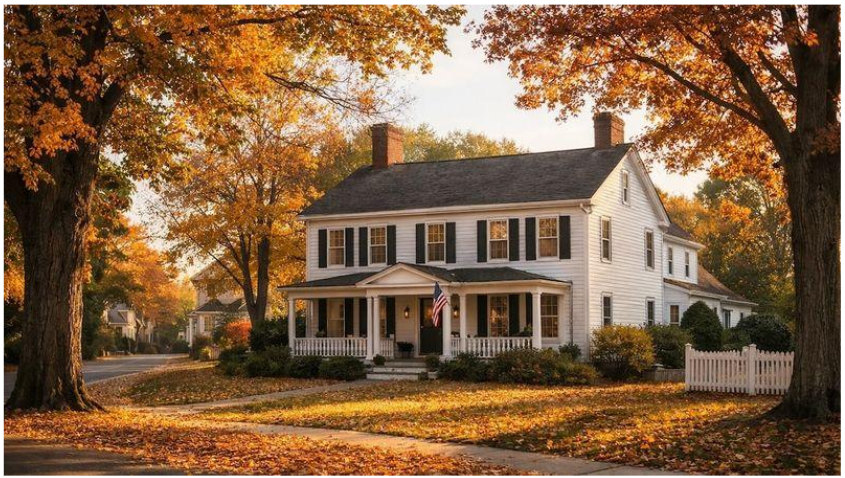
The Houses That Tell Connecticut’s Story: An October Road Trip Through Centuries of New England Architecture
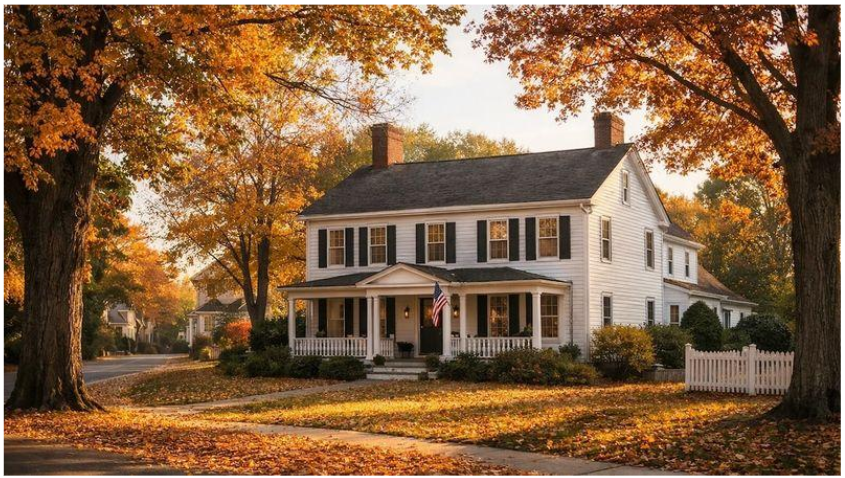
October has a way of making everyone look at Connecticut differently.
We notice the hills.
We notice the stone walls.
We notice the winding roads framed by red, orange, and gold.
But this October, look beyond the leaves.
Look at the houses.
Connecticut has more than four centuries of residential history preserved across the state, from some of its earliest surviving homes to grand estates and modern architectural landmarks.
Some sit prominently along historic Main Streets. Others appear unexpectedly around a bend in a country road. Some have been carefully preserved as museums, while countless others remain private homes woven into everyday neighborhoods.
Together, they tell a story about how Connecticut grew, changed, worked, prospered, and lived.
And October may be one of the most beautiful times to notice them.
So instead of planning another fall weekend entirely around foliage, try something different.
Take an architectural road trip.
Because sometimes Connecticut's most interesting history isn't behind museum glass.
It's right there beside the road.
Start With the Homes That Have Seen Centuries Pass
There's something humbling about standing in front of a house that existed long before highways, shopping centers, automobiles, electricity, or even the United States itself.
Connecticut has examples dating back to its earliest colonial settlements.
The Henry Whitfield State Museum in Guilford dates to 1639 and is recognized as Connecticut's oldest house and New England's oldest stone house. In Norwich, the Leffingwell House dates to 1675 and began as a pre-Revolutionary tavern. CTvisit
Those dates can be difficult to comprehend until you're actually standing near one of these places.
Suddenly, history isn't an abstract chapter in a textbook.
It has windows.
A doorway.
A chimney.
Floorboards.
Rooms where people cooked meals, raised children, worried about winters, welcomed visitors, and watched a completely different Connecticut outside their windows.
October adds another layer.
Leaves collect along stone walls. Late-afternoon sunlight falls across weathered siding. Mature trees frame houses that have watched hundreds of autumns arrive and disappear.
The season makes history feel strangely close.
Colonial Connecticut Was Built for Life, Not Instagram
Today, we admire old Colonial homes for their symmetry and simplicity.
But the people who built them weren't trying to create a timeless New England aesthetic.
They were building practical places to live.
Early Connecticut homes often reflected the realities of climate, available materials, craftsmanship, and family life.
Wood was abundant.
Fireplaces were essential.
Windows were smaller than what we'd expect in modern construction.
Floor plans evolved around everyday needs rather than open-concept entertaining.
And yet, centuries later, many of those design choices have become part of the visual language we immediately associate with New England.
Simple rooflines.
Central chimneys.
Wood siding.
Multi-pane windows.
Hand-built stone walls.
Architecture created out of necessity eventually became architecture associated with place.
That's one of the fascinating things about exploring historic homes in Connecticut.
You're not simply looking at design.
You're looking at how previous generations solved the problem of living here.
Then Connecticut Became More Refined
As communities grew and prosperity increased, Connecticut's homes changed with them.
Architecture became another way to communicate taste, success, and sophistication.
Federal-style homes brought greater refinement and symmetry to the landscape.
Entrances became more decorative.
Windows became larger.
Details became more delicate.
Interior spaces evolved.
Connecticut's official tourism resources highlight the Phelps-Hatheway House in Suffield as an example of Federal-style architecture, surrounded by landscaped grounds and gardens. CTvisit
Drive through older Connecticut communities today and you'll often see these architectural eras sitting surprisingly close together.
A modest early house.
A stately Federal residence.
A Victorian several blocks away.
A 20th-century home around the corner.
A modern renovation nearby.
The street becomes a timeline.
Victorian Connecticut Wasn't Afraid to Show Off
Then came an era when architecture became considerably more expressive.
Victorian-era homes brought towers, porches, decorative trim, elaborate windows, unusual rooflines, bold proportions, and details that practically demand that you stop and look.
Connecticut's industrial growth helped create wealth that supported some extraordinary architecture. CTvisit's Victorian architecture tour highlights properties including Lockwood-Mathews Mansion in Norwalk, Gillette Castle, and Roseland Cottage in Woodstock. \
The Lockwood-Mathews Mansion, built between 1864 and 1868, is considered one of the country's significant early examples of a Second Empire country house.
These aren't quiet buildings.
They're architecture with personality.
And against an October backdrop?
Even better.
Ornate porches surrounded by autumn leaves.
Turrets against a brilliant blue October sky.
Dark woodwork contrasted with orange foliage.
It's difficult to imagine a more naturally cinematic setting.
Don't Forget Connecticut's Farmhouses and Barns
Not every building that tells Connecticut's story is grand.
Some of the most recognizable structures in the state are far simpler.
Farmhouses.
Barns.
Outbuildings.
Stone walls.
Old fields.
These buildings remind us that much of Connecticut's landscape was shaped by agriculture.
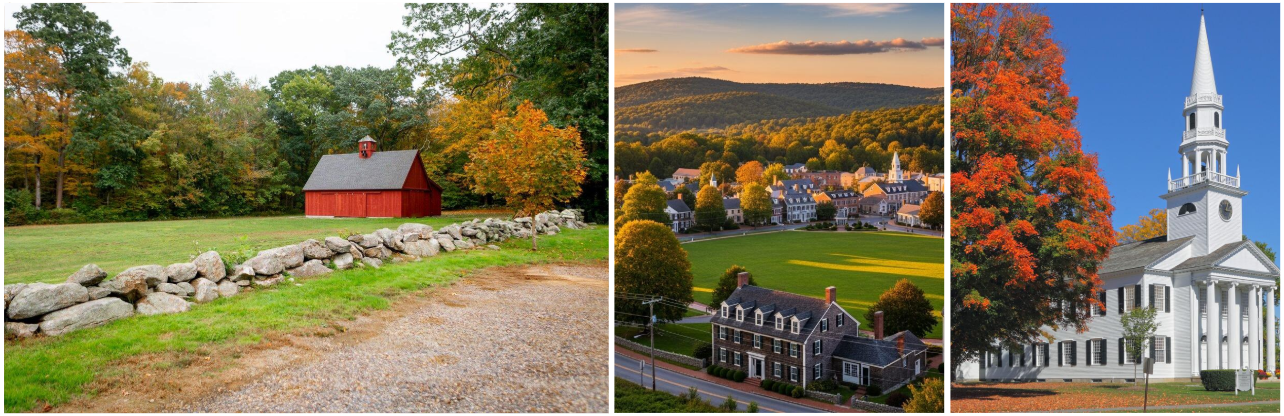
Drive through rural portions of Litchfield County, the Farmington Valley, eastern Connecticut, or communities along the Connecticut River and you'll still encounter landscapes where architecture and land seem inseparable.
A weathered barn behind a stone wall.
A farmhouse facing an old road.
A field stretching toward wooded hills.
A small cemetery beneath mature trees.
These scenes don't need dramatic architecture to feel historic.
Their power comes from continuity.
People have been traveling some of these roads, working these fields, and watching autumn arrive here for generations.
The Stone Walls Deserve Their Own Road Trip
If Connecticut architecture tells the story of its buildings, the state's stone walls tell the story of its land.
They're everywhere once you start noticing them.
Along roads.
At the edges of old properties.
Running through forests.
Dividing fields that may no longer exist.
Some appear almost impossibly straight. Others disappear beneath vegetation and reappear farther down the road.
Connecticut's landscape is famously dotted with these reminders of earlier settlement and farming. Even the state's official fall tourism guidance calls out the stone walls along scenic Route 169 as evidence of the labor of early settlers.
In October, fallen leaves collect against them, making their shapes easier to notice.
The next time you're on a scenic Connecticut drive, don't only look at the trees.
Look beneath them.
Main Streets Became Architectural Scrapbooks
As Connecticut towns developed, their centers accumulated architecture from different generations.
That's why a walk through an older downtown can be so interesting.
You might find an 18th-century house near a 19th-century church, a Victorian commercial building beside an early 20th-century storefront, and a converted mill serving an entirely new purpose.
Rather than being perfectly preserved snapshots of one era, many Connecticut town centers are architectural scrapbooks.
Pieces were added over time.
Uses changed.
Buildings were expanded.
Storefronts evolved.
And somehow, the layers became part of the character.
This is especially noticeable in Connecticut historic districts, where the relationship between individual buildings, streets, sidewalks, greens, trees, and public spaces often matters just as much as any single property.
The Town Green Tells Another Part of the Story
Architecture doesn't exist in isolation.
Look at what surrounds it.
In many historic Connecticut communities, the town green remains one of the most recognizable organizing features.
Churches, civic buildings, historic homes, businesses, and streets often developed around or near these shared spaces.
Today, greens may host concerts, farmers markets, festivals, ceremonies, or simply someone walking a dog on an October afternoon.
Their uses have evolved.
Their role as gathering places hasn't entirely disappeared.
When you're exploring historic towns in Connecticut, spend a few minutes on the green rather than simply driving around it.
Turn slowly.
Look at the buildings facing it.
You'll often understand the community differently.
Then the Mills Changed Everything
Connecticut's architectural story isn't only Colonial houses and charming town greens.
Industry transformed the state.
Factories and mills grew near rivers and transportation routes, creating jobs, neighborhoods, and entire communities around manufacturing.
Those buildings looked very different from traditional homes.
Large windows.
Brick walls.
Heavy timber.
Tall ceilings.
Broad industrial footprints.
They were built to make things.
Today, many former industrial buildings throughout New England have been adapted for completely different uses.
Apartments.
Offices.
Restaurants.
Studios.
Shops.
Community spaces.
Adaptive reuse is one of the most interesting chapters in Connecticut architecture because it asks a simple question:
What happens when a building outlives its original purpose?
Sometimes the answer is demolition.
But sometimes it's reinvention.
And when it's done thoughtfully, an old building gets to begin another chapter.
Connecticut Didn't Stop Building in 1900
Historic architecture gets plenty of attention, but Connecticut's design story didn't end with Colonial houses and Victorian mansions.
The state also became home to significant modern architecture.
One of the best-known examples is Philip Johnson's Glass House in New Canaan, completed in 1949. Connecticut tourism officials describe it as a masterwork of modern American architecture, and the surrounding landscape makes it particularly striking in autumn.
That contrast is important.
A Connecticut architecture road trip can take you from a 17th-century house to an ornate Victorian property and eventually to a radically modern glass structure.
All within the same relatively small state.
That's an extraordinary architectural range.
Some Houses Tell the Stories of Remarkable People
Sometimes the building matters because of who lived there.
Connecticut has preserved homes connected to writers, artists, political figures, soldiers, entrepreneurs, architects, and other people whose influence reached far beyond the state's borders.
Mark Twain and Harriet Beecher Stowe are among the most recognizable examples, while other historic properties include the birthplace of Noah Webster and the Nathan Hale Homestead.
Then there is Hill-Stead Museum in Farmington.
The home was designed by Theodate Pope Riddle, one of America's pioneering female architects, for her family and today combines architecture, art, landscape, and history in one setting.
These places remind us that houses are never only collections of materials.
They're containers for people's lives.
And sometimes those lives change history.
October Changes the Way We See Architecture
Why make this an October road trip?
Because fall does something interesting to buildings.
In summer, trees can partially hide architectural details.
In winter, everything is exposed.
But October creates contrast.
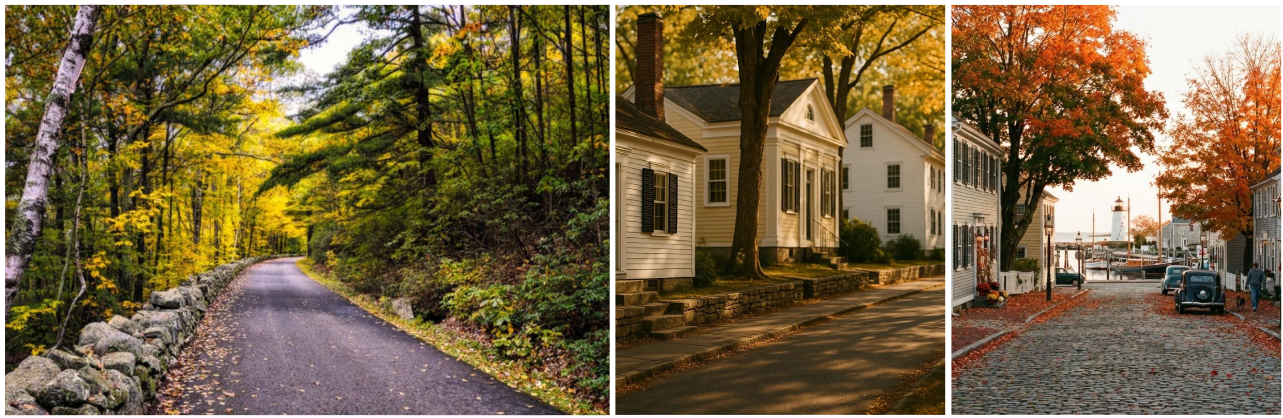
White clapboard against orange leaves.
Red brick beneath yellow trees.
Dark shutters against brilliant foliage.
Stone walls covered in fallen leaves.
Barns surrounded by fields turning gold.
The lower autumn sun also creates stronger shadows and warmer light, revealing textures you may overlook during other seasons.
Suddenly, an ordinary drive becomes a study in color, material, proportion, and history.
That's why some of the best Connecticut fall road trips aren't only about where the foliage is brightest.
They're about what the foliage frames.
Build Your Own Connecticut Architecture Road Trip
You don't need to cover the entire state in one weekend.
In fact, don't.
Choose a region.
If you're near Hartford County, explore Farmington, Wethersfield, Hartford, or Suffield.
Head toward the shoreline and you'll find centuries of history in places like Guilford and Old Lyme.
Travel northwest and architecture becomes part of the classic Litchfield Hills landscape.
Go east and scenic roads connect historic communities, farms, stone walls, and properties that feel quintessentially New England.
Route 169 through northeastern Connecticut is particularly associated with historic towns, rural scenery, stone walls, and fall color.
The goal isn't to check off buildings.
It's to notice how architecture changes as you travel.
A Better Way to Explore: Pick an Era
Here's a fun twist for your next October weekend.
Choose an architectural era instead of a destination.
Maybe today is Colonial Connecticut.
Another weekend, search for Victorian architecture.
Or make it a barn-and-stone-wall drive.
Visit a historic estate.
Explore converted mills.
Find a modern architectural landmark.
Once you start looking for a particular style, you begin seeing examples everywhere.
It's almost like learning a new language.
At first, every old building simply looks “historic.”
Then you begin noticing rooflines.
Windows.
Chimneys.
Materials.
Porches.
Symmetry.
Decorative details.
And suddenly, Connecticut starts telling you when its buildings were born.
Historic Homes Can Teach Us Something About Modern Living
One of the most interesting parts of exploring old homes is noticing how much our expectations have changed.
Today's buyers often talk about open floor plans, large kitchens, primary suites, storage, natural light, home offices, energy efficiency, and indoor-outdoor living.
Older houses were built around entirely different lifestyles.
Families used rooms differently.
Technology changed.
Heating changed.
Transportation changed.
Privacy changed.
Entertainment changed.
Even our relationship with the kitchen changed.
Yet certain things remain remarkably familiar.
People still want comfortable gathering spaces.
Natural light still matters.
Location still matters.
A sense of home still matters.
Architecture changes because life changes.
That's what makes looking backward so interesting.
Preservation Isn't About Freezing a Town in Time
Preserving historic architecture doesn't mean refusing to change.
Communities are living places.
Buildings need new uses.
Homes need modern systems.
Downtowns need businesses.
Neighborhoods need to evolve.
The interesting question is how communities can move forward while keeping the elements that make them recognizable.
Sometimes preservation means restoring an important historic property.
Sometimes it means adapting an old mill.
Sometimes it's keeping the scale of a historic streetscape intact while allowing new life inside its buildings.
The strongest communities often aren't places where nothing changes.
They're places where change understands what came before it.
A Simple October Architecture Day
Start with coffee somewhere local.
Choose one historic town or district and walk rather than immediately driving through.
Look at the houses.
Notice the rooflines.
Find the oldest building you can.
Walk around the town green.
Stop at a historic home that's open to visitors.
Have lunch locally.
Then choose a scenic road toward your next town.
Stop when you see a barn worth photographing.
Notice the stone walls.
Take the road that looks interesting.
And if you happen to find spectacular foliage along the way?
Consider it a bonus.
The Best Connecticut Stories Aren't Always Written Down
A house doesn't need a plaque to have a history.
Someone chose where it would sit.
Someone selected its materials.
Someone built it.
Families moved in and out.
Rooms changed purpose.
Trees grew around it.
Roads widened.
Neighborhoods developed.
Generations passed.
Some buildings survived.
Others didn't.
That's why architecture is such an interesting way to explore Connecticut.
It turns the landscape into evidence.
Every house becomes a clue.
Final Thoughts: This October, Look Beyond the Leaves
Connecticut in October is undeniably beautiful.
Take the foliage drive.
Visit the orchard.
Drink the cider.
Enjoy every unapologetically autumn thing you can.
But somewhere along the way, look beyond the trees.
Notice the Colonial house behind them.
The Victorian porch beneath them.
The old barn across the field.
The brick mill beside the river.
The stone wall disappearing into the woods.
The town green surrounded by buildings from another century.
The modern home that challenged everything that came before it.
Because Connecticut's landscape isn't beautiful only because of what grows here.
It's also beautiful because of what generations of people have built here.
This October, take a closer look at the history hiding in plain sight.
You may discover that some of Connecticut's best stories have been standing beside the road all along.

Sandie Terenzi
CEO, Broker Associate | Sandie Terenzi | Keller Williams Legacy Partners | PLACE
or another way